Strategy before devices
Define the owner's outcomes, data needs, support model, and integration boundaries before products are selected.
A field guide for the people making buildings work
How the Fourth Trade Connects It All with the Purdue Model
Stop integrating at the end. Start with the owner's goals, create a common architecture, and let every building system do its job—together.
01 / THE PROBLEM
Buildings are expected to operate as connected systems. They are still planned and delivered as separate islands.
HVAC, lighting, security, audiovisual, fire alarm, metering, and IT arrive with different scopes, timelines, networks, and assumptions. The gaps surface late—when change is expensive and everyone is blaming someone else.
Smart Buildings by Design offers a practical way out: recognize technology as the Fourth Trade and plan from enterprise intent down to the physical process.
02 / THE FOURTH TRADE
The T in MEPT is more than structured cabling or a collection of low-voltage packages. It is the discipline that connects mechanical, electrical, plumbing, operations, and enterprise goals into one durable technology architecture.
“Stop being the last system planned. Start being the first conversation in the room.”
03 / THE FRAMEWORK
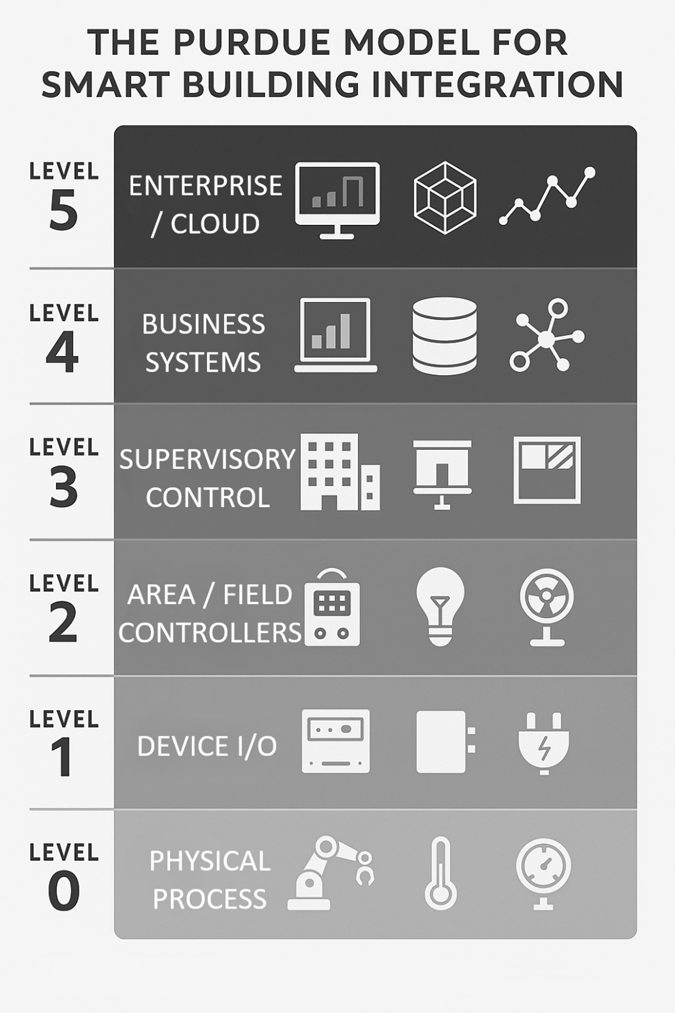
The Purdue Model gives owners, IT teams, designers, contractors, and controls professionals a common language. Beginning with Levels 4–5 makes the business outcomes visible before hardware choices lock the project into a path.
04 / WHAT CHANGES
Define the owner's outcomes, data needs, support model, and integration boundaries before products are selected.
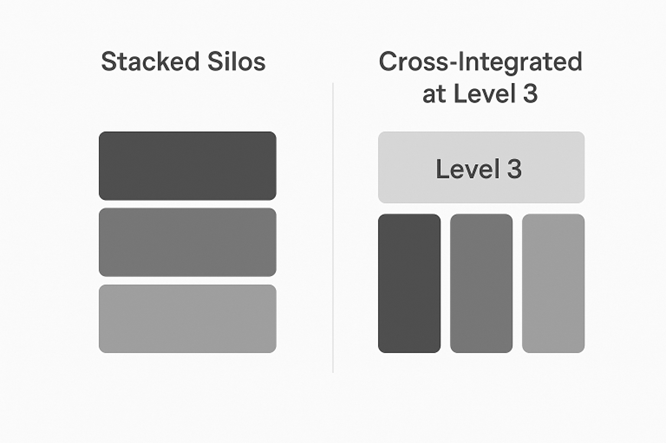
Keep systems strong on their own and connect them through deliberate, replaceable interfaces.
Use Division 25 or an equivalent structure to name roles, responsibilities, and acceptance criteria.
Treat OT cybersecurity, remote access, updates, and response as lifecycle disciplines—not turnover accessories.
05 / WHO IT IS FOR
Connect technology decisions to risk, lifecycle value, and the outcomes the organization actually needs.
Define integration roles early, close scope gaps, and stop leaving the technology plan until turnover.
Create a common language for networks, controls, cybersecurity, operations, and long-term support.
Lead the conversation above the protocol level—and build systems that can change without starting over.
06 / INSIDE THE BOOK
Across 334 print pages, the book moves from enterprise strategy through system architecture, delivery, cybersecurity, and long-term operations.
Part I Strategy, enterprise integration + architecture
Part II Trades, systems + connection points
Part III Delivery, governance + lifecycle planning
Includes icon-coded checklists, case studies, cross-trade matrices, sample requirements, and an OT incident-response framework.
08 / GET THE BOOK
Available in paperback and ebook. Published by Logicmaker Intelligence.
Paperback ISBN 979-8-9988130-0-9